
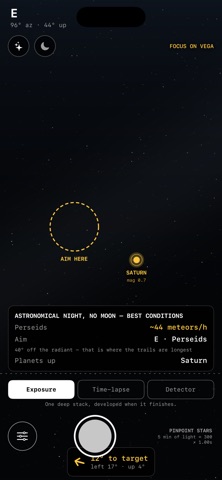
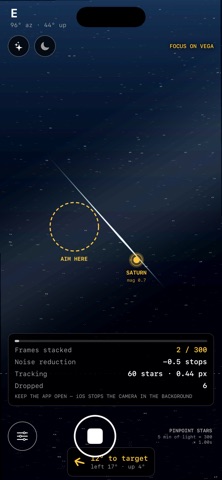

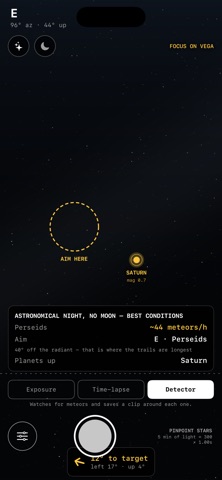
Starlapse
Built on 2026-08-13, the night the Perseids peaked, because no camera app would hold an exposure setting and none would say where to point.
Public, MIT: github.com/fortunto2/starlapse
The three hardware facts it is built around
Every design decision follows from these, and each contradicts something people bring from DSLR astrophotography:
- Aperture is not adjustable. iPhone lenses have fixed apertures. “Opening up” means picking a faster lens (main ≈ f/1.78 vs ultra-wide f/2.2), nothing more.
- A single frame caps at ~1 second.
activeFormat.maxExposureDuration. Night mode’s 30 s is private API. Everything longer is stacked — which is better than a long exposure, because noise falls as √N and the same frames can be developed as pinpoint stars or star trails afterwards. - Capture cannot run in the background. iOS force-stops
AVCaptureSession. The honest substitute isisIdleTimerDisabledplus a dimmed screen.
The UI states all three rather than hiding them: a “10 minute exposure” is shown as “600 × 1.00s”.
What is worth stealing from it
The domain is platform-free. SkyKit (where things are in the sky) and StackKit (star
detection, frame registration) import only Foundation and simd. 43 tests run in 3 seconds on
a Mac with no simulator. A CLI, starlapse-sky tonight --lat … --lon …, drives the same code
— CLI-first testing that actually earns its keep.
Tests anchored to external facts, not to their own output. Polaris altitude equals
latitude; the synodic month falls out of the periodic terms; the Moon is new on the day of
the 2026-08-12 solar eclipse. When a test failed, the maths was right and the test’s own
constants were wrong — three of four raw timestamps pointed at a different day than their
comment claimed. Now: no magic timestamps, only utc(y, m, d, h).
Alignment proven arithmetically. Star registration is tested against synthetic fields rotated by a known angle, recovering it to 0.05°. A misaligned stack just looks like a slightly soft photo — you would find out in a field at 2am.
Where to aim is not where the radiant is. Meteors streak away from the radiant, so the longest trails are 40° off to the side. The app computes that, keeps clear of the Moon, and picks a height a tripod can hold. That is the part that earns the app.
Lessons that generalise
- swift6-callback-isolation — the crash that survived two rounds of fixes aimed at the wrong subsystem. Pull the crash report before theorising.
- A comment that promises what the code does not do is worse than no comment. The ring buffer’s doc said “the event lands in the middle of the clip”; it was sized to the pre-roll only, so the post-roll evicted the history and one frame survived. Another cited a camera format preference that did not exist — 300 MB of ring buffer and 200 MB/s of memcpy.
- Never derive a state’s purpose from a combination of other fields.
isFramingmeant “no segment count”; then watching arrived, which also has no segment count, and the stop button silently did nothing. Twice from the same root, so purpose is stored now. - Screenshots without faking. The Simulator has no camera, so a synthesised sky is fed through the real pipeline — same stacking, same alignment, same curve. A meteor crosses because the app is built to catch meteors. No comet: those come every few years, and a screenshot promising one promises a buyer something they will not get.
Status
TestFlight, build 2. Store listing complete, asc validate clean. Release mechanics in
docs/store/RELEASE.md.
Unproven where it matters: the time-lapse path has never run to completion and the detector has never seen a meteor. Everything above the domain layer is verified by reasoning and compilation, not by photons.