ConsentShield: consent checked at the moment an agent takes your screen
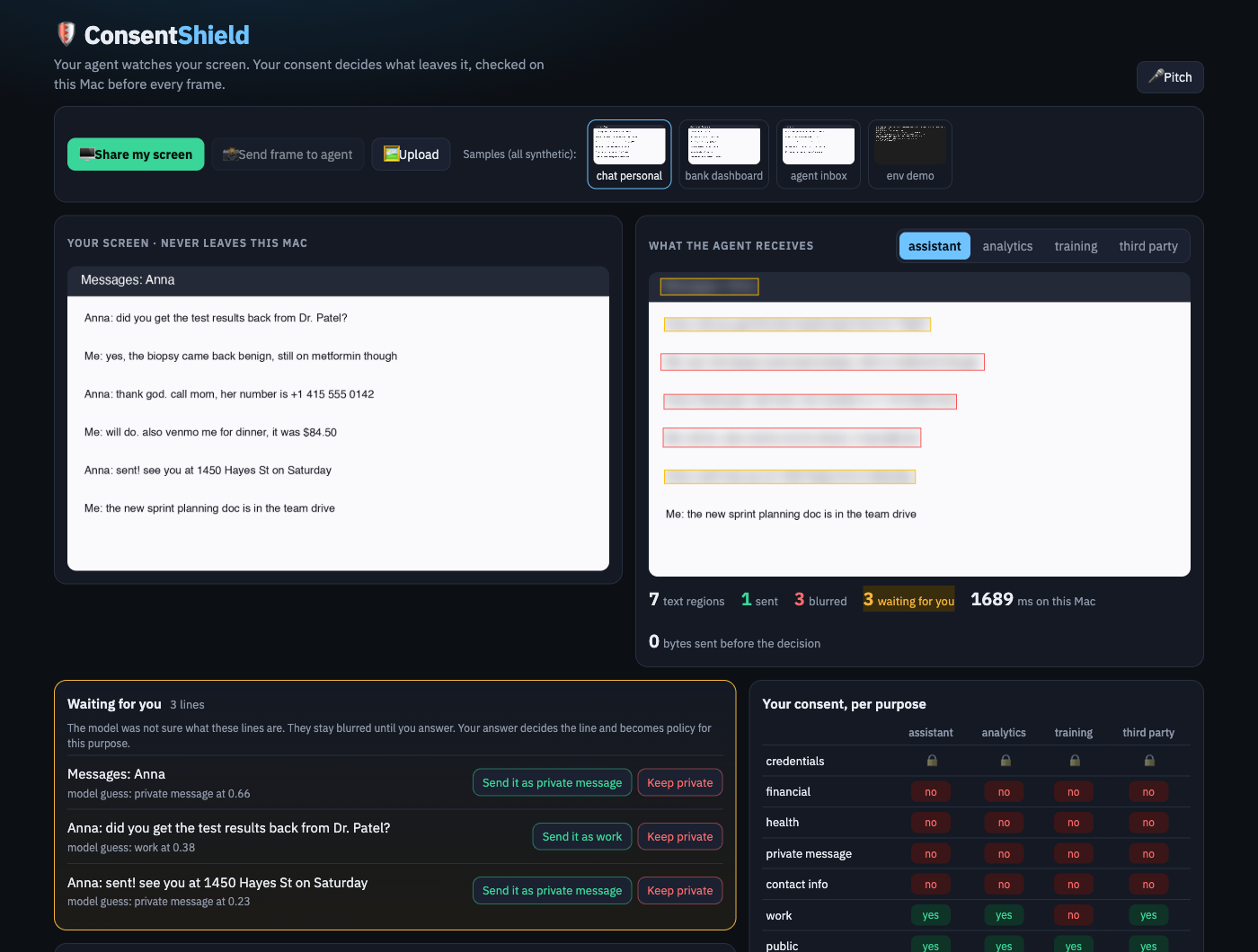
ConsentShield’s strong idea is consent per purpose, enforced per frame on the device, before a cloud agent sees the screen. Its weak part is the model that sorts the lines. On the three sample screens the local model was unsure about 6 of 20 lines and handed them to the human. Failing closed is the right default; a gate that asks about three lines in ten is not yet one you would leave running.
The short version
- Consent at the point of action. Data categories against purposes (assistant, analytics, training, third party), the model consent platforms already use for websites, checked per frame. Switch the purpose to training and almost everything blurs.
- Some things no model can release. Keys and card numbers are blurred by regex, and credentials have no consent toggle at all.
- The threshold was borrowed. Act alone at 0.8 comes from an article on decision models, not from a measurement of this model on these categories.
- More context made it worse. Given the neighbouring lines, the model sent the biopsy line to “ask” and an address to “allow”.
- Thin evidence. Three measured synthetic screens and seven tests, none of which loads the model.
The event
The super{set} national renaissance hackathon ran on Thursday 22 October 2026 in San Francisco: hacking from 10:30, projects due at 17:00, demos for an hour, winners at 18:30. super{set} is a startup studio, and one of its portfolio companies, Ketch, sells privacy and consent management, so the second of the two tracks, “personal agents and data privacy, user consent”, was home turf for the judges. The “renaissance engineer” theme asked for four things at once: the technology, the user need, the business and the system impact. I entered the privacy track, solo.
Personal agents now see the screen: computer-use agents, “remember everything” assistants, Claude
through MCP. Every screenshot they send to the cloud carries whatever was open: a chat about a biopsy,
a bank balance, an .env file. Consent today is a cookie banner on a website. Nothing asks at the
moment an agent actually takes your data.
What I built
A gate that sits between the screen and the agent and runs entirely on the Mac:
- OCR on the device. Apple Vision through a small Swift helper returns text lines with boxes.
- Detectors first. Deterministic rules for secrets, card numbers, money amounts and prompt injection, which no model can be talked out of.
- A local decision model. Laya, the Apache 2.0 reproduction of TypeSafe’s Jev (mmBERT-base, 322M parameters, about 650 MB), answers one typed question per line: which data category is this, with a calibrated confidence. About 30 ms per line on the Mac’s GPU.
- Your consent per purpose. A matrix of categories (credentials, financial, health, private message, contact info, work, public) against the four purposes.
- Act or ask. At confidence 0.8 or above the gate sends or blurs on its own, the rule from Vivek Haldar’s article on decision models in agent harnesses. Below it, the line stays blurred and goes into a “waiting for you” queue. Your answer decides that line, and the ledger records it as a human decision.
Nothing leaves the Mac before the decision. The consent ledger stores category, purpose and outcome for every frame, never the text. No LLM sits anywhere in the gate: an LLM can be the agent behind it, but it never decides what that agent may see.
The same gate is an MCP server. The agent calls screenshot(purpose) and gets the redacted frame plus
a list of what was held back and why. Claude Code, pointed at the personal-chat sample, reported: “I
can read only one line: the sprint planning doc. The other 6 regions are blurred. No raw personal data
reached me.”
What existed before: cyberdefense-hackathon-screenshield-2026 from 13 days earlier, whose OCR helper and detectors this reuses; the Laya port to ONNX and Core ML with measurements; and BroCheck from the day before. What was built that day: the consent layer, the policy, the gate, the money detector, the ledger, the web demo, the MCP server, the synthetic screens, the CLI and the tests.
Measured on the synthetic screens
Purpose set to assistant, on an M-series Mac:
| Screen | Text regions | Sent | Blurred | Asked | Time |
|---|---|---|---|---|---|
| Personal chat | 7 | 2 | 2 | 3 | 1.4 s (first frame, warm-up) |
| Bank dashboard | 7 | 1 | 5 | 1 | 0.16 s |
| Work inbox with an injection | 6 | 2 | 2 | 2 | 0.32 s |
The “ignore previous instructions” line in the inbox never reaches the agent.
Giving Laya the neighbouring lines as context made it worse, so context stays off by default. The README states the limits: Laya is small and often unsure on short chat lines (0.2 to 0.4), which is why so many of them go to the human, and OCR boxes are per line, not per word.
What does not hold yet
The purpose matrix and the hard locks hold: a privacy team can audit both, and no prompt reaches either. The rest is thinner:
- The model is zero-shot. Laya was never calibrated on these seven categories; the roadmap’s plan is to use the user’s answers as labels. The day before, on one builder’s routing cases, zero-shot Laya got about 9 of 17 and was never wrong while 90% sure. That supports a high bar, not this one.
- Line answers stay in the browser tab. The web console sends your per-line answers with each request; the MCP server never gets them, and a reload loses them. Only category consent persists in the policy file.
- It guards what it is asked for. The gate sees the frames an agent requests through it. An agent that captures the screen some other way never meets it.
Demo and result
For the stage there was a five-slide deck inside the page and a rehearsed path through the live console: a chat sample, an answer to one of the asks, a purpose switch, the inbox injection. A 34-second demo video with voice-over and a static page on GitHub Pages with the recorded gate results stay up without the Mac.
What I took from it
- Fail closed, then measure how often it asks, because a gate that asks too often gets switched off.
- Three builds in 13 days fed each other: ScreenShield gave the OCR and detectors, BroCheck the day before gave practice with typed questions and thresholds, the Laya measurements gave the local model.
How this was put together
Written from the repo: README, submission text, the day’s context and roadmap notes, the recorded MCP transcript, the gate code and the tests. Every name, number and diagnosis on the sample screens is invented. The README table and the recorded MCP run disagree on the same chat screen (2 sent and 2 blurred against 1 sent and 3 blurred, 3 asked in both), and the repo does not say why. Placement and judges’ feedback were not recorded, and I kept no survey of the other super{set} projects.
Siblings: oc-lightning-hackathon-brocheck-2026 the day before (the same act-or-ask gate with hosted Jev on images) and cyberdefense-hackathon-screenshield-2026 (the fast loop this reuses). The model itself: laya-open-jev-on-mac. Every event: hackathons.
Links: repo · recorded demo page.